
Aligning Decisions Like a Boss. Turning Purpose, Vision and Values into better everyday decisions
Most organisations don’t struggle to write their Purpose, Vision and Values. They struggle to use them.
Too often they become three separate statements. They appear on the website, sit in the annual report or hang on the wall in reception. But when someone is faced with a difficult decision on a Tuesday afternoon, they’re rarely the first things that come to mind.
That got me wondering if the problem isn’t the words themselves. Perhaps we’ve simply never been shown how they fit together.
Curious to see whether there was a pattern, I started mapping annual reports from different organisations into a simple framework. Instead of reading Purpose, Vision and Values as separate statements, I looked at how they connect.
Something interesting happened. The organisations with the clearest strategic direction weren’t necessarily the ones with the best-written Purpose, Vision or Values. They were the ones where each element reinforced the others. Together they created a practical framework for making decisions.
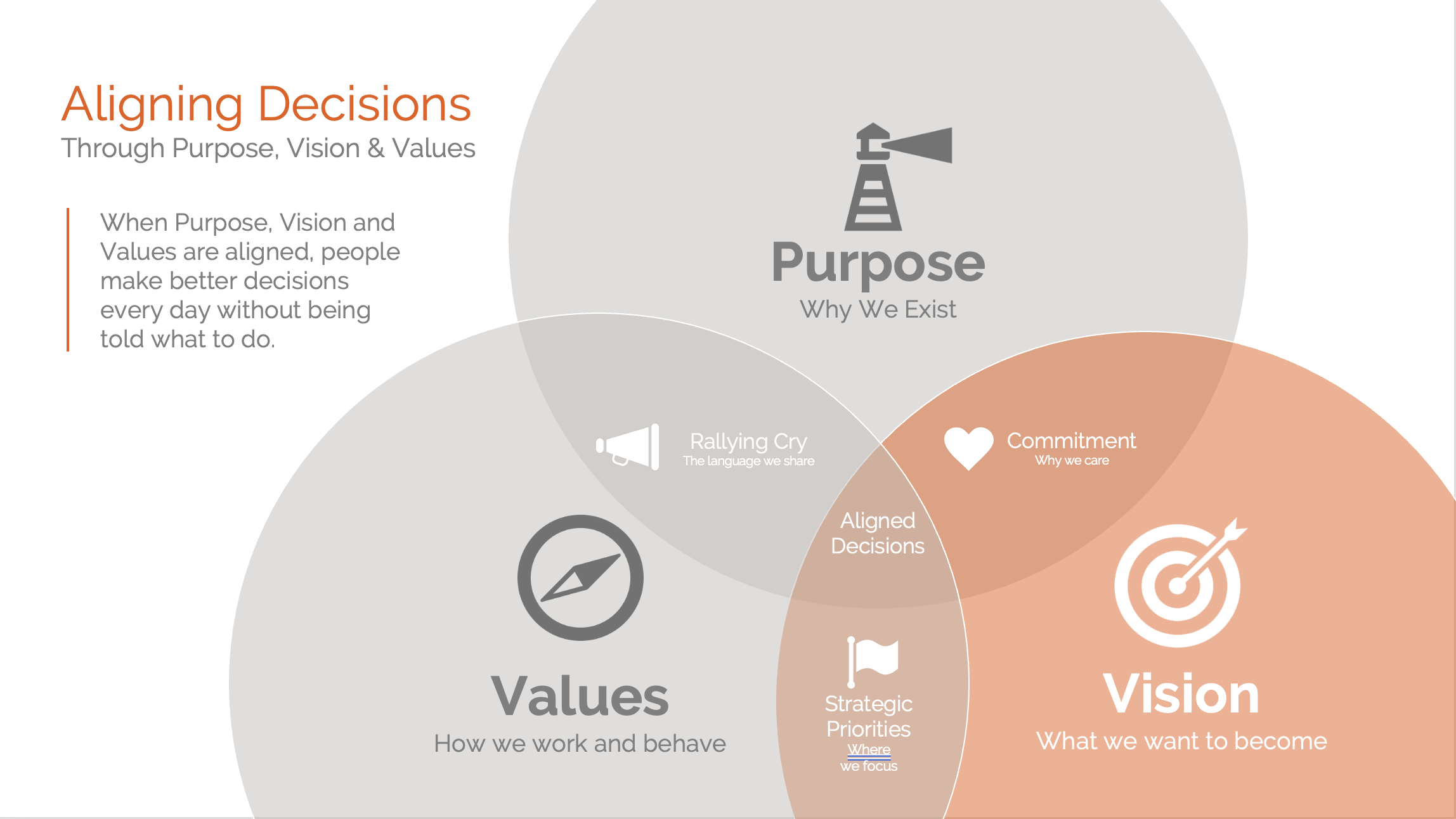
Purpose answers the question, Why do we exist?
Vision answers, What do we want to become?
Values answer, How will we work and behave along the way?
Those three foundations are important, but it’s the overlaps that make the framework useful.
When Purpose and Values come together, they create a Rallying Cry. These are the messages that get repeated in meetings, town halls and corridor conversations. They’re the phrases people instinctively use because they capture what matters most.
When Purpose and Vision come together, they create Commitment. People understand not only where the organisation is heading, but why the journey is worth making.
When Vision and Values come together, they become Strategic Priorities. The organisation gains clarity about where to focus its energy, investment and attention.
At the centre sits Aligned Decisions. That’s the real outcome. When these elements reinforce each other, people make better decisions every day without needing to be told what to do.
Air New Zealand provides a good example.
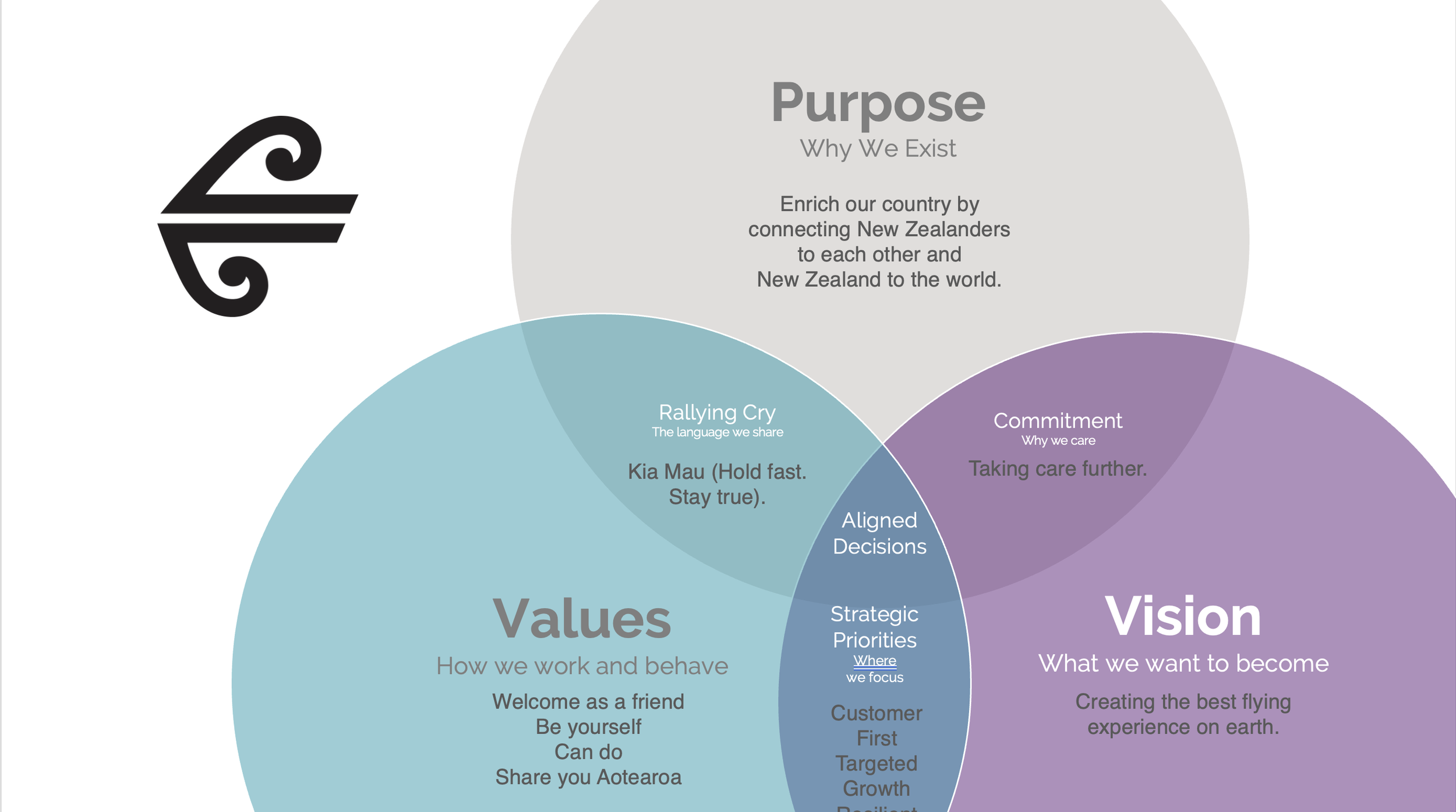
The first three elements come directly from Air New Zealand’s published strategy. The remaining elements are my interpretation of how those pieces come together.
Its Purpose is clear: enriching New Zealand by connecting New Zealanders to each other and New Zealand to the world.
Its Vision is equally clear. It wants to build the world’s leading digital airline while helping shape a more sustainable future for aviation.
Its Values, centred around Manaaki, define how people work together and how customers, colleagues and communities are treated.
The overlaps are where things become interesting.
Its Rallying Cry is Kia Mau. Literally translated, it means hold fast, stay true or keep going. Throughout the annual report, it becomes more than a slogan. It is the language that connects people back to the strategy and reminds them what they are working towards.
Its Commitment is reflected in its ambition to care for New Zealand, its people and its customers while building an airline that will endure for generations. It explains why the strategy matters.
Its Strategic Priorities are also explicit. Growing the domestic network. Strengthening international services. Building loyalty. Investing in digital capability. Advancing sustainability. They turn aspiration into choices about where time, money and effort should be invested.
Viewed individually, they’re statements. Viewed together, they’re a decision-making framework. Whether someone is deciding where to invest capital, designing a new customer experience or improving an internal process, the same framework provides direction. Purpose explains why. Vision provides the destination. Values shape behaviour. The Rallying Cry keeps the message alive. Commitment builds belief in the journey. Strategic Priorities focus attention.
That’s what good strategy should do. It shouldn’t just explain what the executive team is thinking. It should help thousands of people make hundreds of consistent decisions every day.
In an earlier article, Simplify Your Strategy Like a Boss, I explored how managers translate organisational strategy into meaningful priorities for their own teams. This framework sits one step before that. It helps leaders connect Purpose, Vision and Values into a practical architecture that guides decisions across the organisation.
Because strategy isn’t measured by how well it’s written. It’s measured by the quality and consistency of the decisions people make every day. Better decisions create better outcomes, and over time, better financial performance. A clear strategy simply makes those better decisions more likely.