
We've all heard people talk about culture. "We've got a great culture here." "The culture has really changed." Or perhaps, "That's how we do things around here."
But when you ask people what makes a culture good or bad, it can be surprisingly difficult to explain.
Culture isn't simply the values on the wall or what an organisation says it stands for. It's what people experience every day. The conversations, decisions, meetings and interactions that shape how things get done. And if you want to change a culture, it helps to understand how it works.
The Culture Pyramid
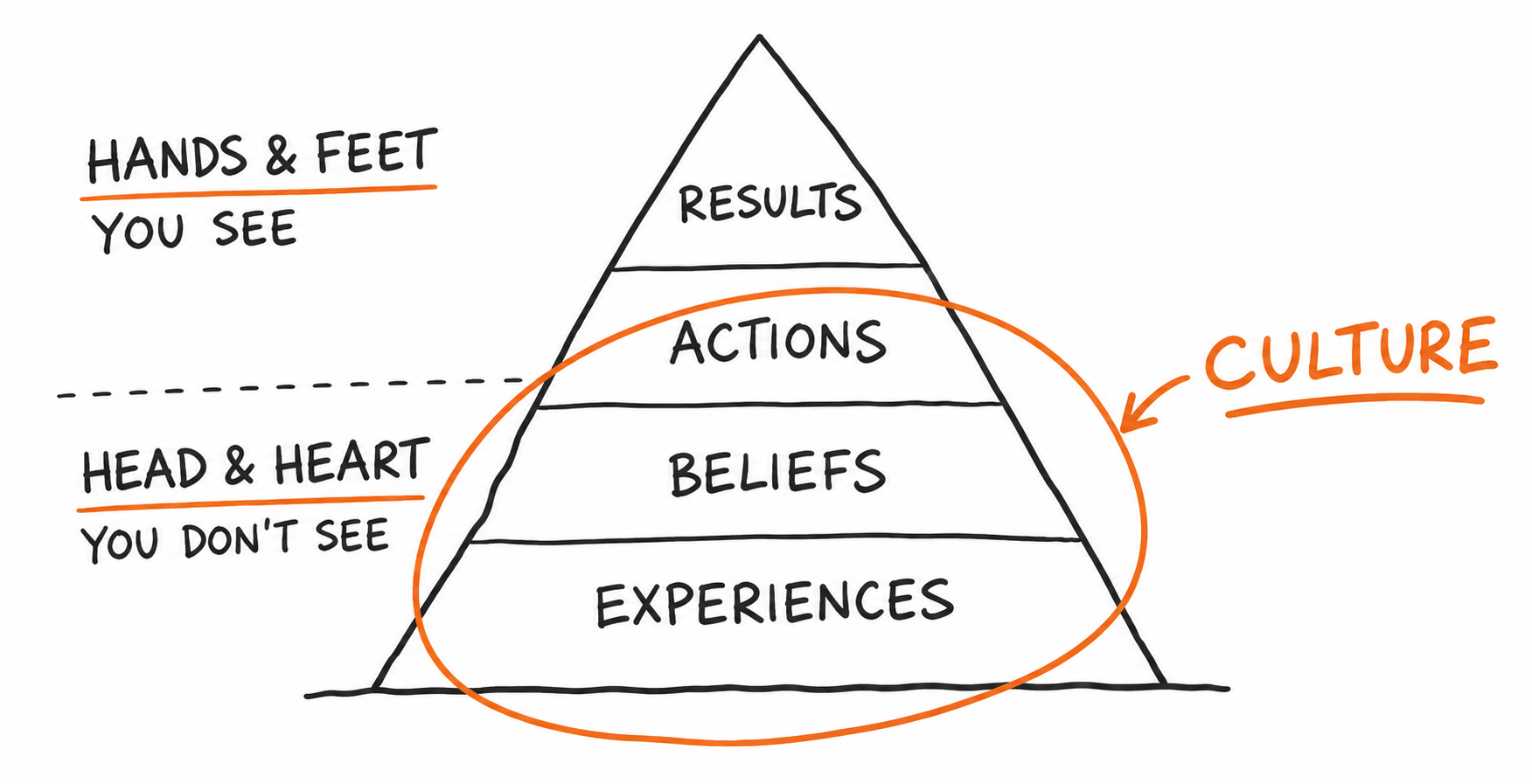
One of my favourite models for helping leaders understand culture is the Culture Pyramid, based on the Results Pyramid developed by Roger Connors and Tom Smith.
It has four levels, working from the bottom up: Experiences → Beliefs → Actions → Results
It's pretty straightforward.
Experiences: What people see, hear and experience at work.
Beliefs: What those experiences lead people to believe is true.
Actions: What people say and do because of those beliefs.
Results: What happens as a consequence.
We tend to focus on the top of the pyramid, the actions and results we can see. But underneath those actions are beliefs shaped by people's experiences. And often, that's where we need to look.
Let's talk about meetings
Here's an example I often use in workshops because most people recognise it. Imagine you've joined an organisation where there seem to be a lot of one-hour meetings. Let's put that through the Culture Pyramid.
Experience: There seem to be a lot of one-hour meetings around here.
Belief: To get any work done, I need to schedule a one-hour meeting.
Action: I start booking one-hour meetings, along with everyone else.
Result: Everyone's diaries become clogged with meetings.
Sound familiar?
Nobody set out to create a culture of endless meetings. There probably isn't a company value that says, "We believe in filling everyone's diaries." But that's what's happened. And it starts to feed itself. People see everyone else in meetings, so they book more meetings. Before long, it's become the normal way to get things done.
So how do we change it?
The obvious response might be to tell everyone to have fewer meetings. Or perhaps introduce a rule that meetings can only be 30 minutes long. That might help, but does it change the belief that's driving the behaviour? What if we created some different experiences instead?
For example:
Hold office hours: Set aside time when people can drop in with quick questions or issues.
Regular 1-1s: Create space to work through bigger issues that need more thought.
Meeting cycles: Use existing team meetings to work through issues rather than organising another one-off meeting.
Now people have different ways of getting things done. Instead of automatically opening their diary to book another meeting, they start asking: "What's the best forum for me to raise this?"
That's quite a shift from "I need to book a meeting to get something done."
And as people start working differently, the results change too. Fewer unnecessary meetings, more space in diaries and more time to get the work done. Not because we told everyone to stop having meetings, but because we helped them see another way.
What behaviour are you trying to change?
There's a connection here to James Clear's Atomic Habits, where he argues that lasting behaviour change isn't simply about what we do, but also what we believe about ourselves. The Culture Pyramid helps us understand how those beliefs form and, importantly, how we can start to change them.
There are two ways to shift a belief. We can create a different experience, as we did with the meeting example, or provide new information that challenges what someone believes.
Imagine someone on your team keeps turning up late for work. You're getting frustrated. You start thinking they're disorganised or perhaps don't really care. Then you find out they're looking after a seriously ill family member and juggling hospital appointments around work.
Does that change how you see them? Of course it does. They're still turning up late, but now you understand what's going on. The new information has changed what you believe about them. It's a good reminder to ask a few questions before jumping to conclusions.
Of course, when we're trying to change how people work, one different experience might not be enough. People need to see that the new way of working is real and consistent. That's why what leaders do every day matters.
So next time you're frustrated because people aren't taking ownership, speaking up or working together, rather than jumping in with another instruction or process, try working backwards through the pyramid.
What have people seen or experienced that makes them think this is how things are done around here?
Because the behaviour that's frustrating you might make perfect sense to the person doing it. And you might find that's where the real work needs to start.
The Culture Pyramid is based on the Results Pyramid developed by Roger Connors and Tom Smith, described in their book Change the Culture, Change the Game (2011).